How autism screening works
Screening is not diagnosis. It's a quick, structured way to decide whether a child should get a full evaluation. Understanding the difference — and the recommended timeline — helps you make sure your child doesn't fall through the cracks.
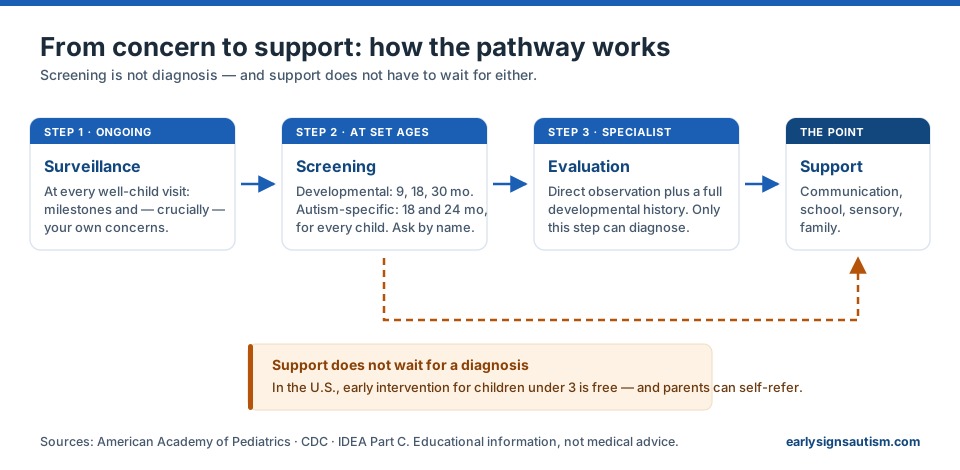
The three levels, in order
-
Developmental surveillance — every visit
At every well-child visit, your child's doctor should ask about milestones and your concerns. This is informal and continuous. Your observations are a core part of it — which is why writing down specific examples matters.
-
Screening — standardized questionnaires at set ages
The American Academy of Pediatrics recommends general developmental screening at 9, 18, and 30 months (typically the ASQ-3), and autism-specific screening for every child at 18 and 24 months (typically the M-CHAT-R/F) — regardless of whether anyone has concerns. Screening is a short parent questionnaire, scored against research-validated cutoffs. The two are not interchangeable: a general developmental screen can be entirely reassuring while autism-specific questions have never been asked.
-
Diagnostic evaluation — the full picture
If screening raises a flag (or concerns persist despite a negative screen), the next step is a comprehensive evaluation by specialists — developmental pediatrician, child psychologist/psychiatrist, or neurologist — using direct observation and standardized tools. Only this level can diagnose autism, and the decision is made against the DSM-5-TR or ICD-11 criteria.
Not screened yet? Screening rates at well-child visits are far from universal. If your child is 18 or 24 months old and no one has handed you an autism questionnaire, it is entirely appropriate to ask for one by name: "I'd like the M-CHAT autism screening done at this visit."
The M-CHAT-R/F: the standard toddler screen
The Modified Checklist for Autism in Toddlers, Revised, with Follow-Up (M-CHAT-R/F) is the most widely used and best-validated autism screening tool for children aged 16 to 30 months.
- What it is: 20 yes/no questions about your child's everyday behavior — pointing, pretend play, response to name, interest in other children, and more. It takes about 5 minutes.
- The follow-up part matters: a medium-risk score should trigger a short structured follow-up interview (the "/F"), which greatly reduces false alarms. High-risk scores go straight to referral.
- Where to take it: free for parents and clinicians at the authors' official site, mchatscreen.com, in many languages. Take the result to your child's doctor — don't stop at the score.
What results actually mean
| Result | What it means | What it does not mean |
|---|---|---|
| Positive / elevated | Your child should have a full diagnostic evaluation and can be referred to early intervention now. Many children who screen positive turn out to have a different developmental condition — most who screen positive on M-CHAT-R/F do benefit from evaluation and support of some kind. | It is not a diagnosis, and not a verdict about your child's future. |
| Negative | No flag at this point in time. Development keeps unfolding — which is exactly why screening repeats at 24 months. | It does not rule autism out, especially in children who mask well or whose signs emerge later. Persistent parental concern outranks a negative screen: if you remain concerned, ask for a referral anyway. |
What a diagnostic evaluation looks like
A comprehensive evaluation typically includes a detailed developmental history with you, direct structured observation of your child (tools like the ADOS-2 are common), assessment of language and cognitive development, plus a hearing test to rule out hearing loss. It may span one long appointment or several shorter ones. You will usually receive a written report — ask for it; it's the key that unlocks services.
Waitlists are real — don't wait idle. Evaluation waitlists of many months are common. Two things to do while you wait: (1) request early intervention services, which in the U.S. require no diagnosis for children under 3, and (2) get on multiple evaluation waitlists and ask about cancellation lists. Support does not need to wait for paperwork.
Sources
- Hyman SL, Levy SE, Myers SM; AAP Council on Children with Disabilities. Identification, Evaluation, and Management of Children With Autism Spectrum Disorder. Pediatrics 2020;145(1) — screening schedule (developmental at 9/18/30 months; autism-specific at 18 and 24 months). publications.aap.org
- Robins DL, Casagrande K, Barton M, et al. Validation of the Modified Checklist for Autism in Toddlers, Revised With Follow-up (M-CHAT-R/F). Pediatrics 2014;133(1):37–45. mchatscreen.com
- M-CHAT-R/F official site (free, multilingual). mchatscreen.com
- CDC. Screening and Diagnosis of Autism Spectrum Disorder. cdc.gov/autism/diagnosis
- Identification-age and screening-reality figures: see the sourced statistics page.
Medical disclaimer: Educational information only, based on AAP screening guidance and the published M-CHAT-R/F validation research. Screening tools referenced belong to their respective authors. This page is not medical advice; consult a qualified clinician about your child.