Autism tests, explained
If you searched for an "autism test," here is the honest landscape: which official instruments exist, what each one actually measures, who administers it, and — most importantly — what no test can do.
The most important fact first. There is no blood test, brain scan, or genetic test for autism. An autism diagnosis is always a clinical judgment made by qualified professionals against the criteria of the DSM-5-TR (US) or ICD-11 (international). The instruments below don't replace that judgment — they structure and inform it.
Which test is relevant for you?
One question: who are you concerned about?
Under 16 months, no autism-specific parent questionnaire is validated yet — but two things are: the CSBS Infant-Toddler Checklist (from 6 months, free) turns your concern into a scoreable data point, and the signs-by-age checklist structures what to watch and mention at the next well-child visit. (Professional surveillance from 12 months does exist — see SACS-R — but it is a program, not something you can run yourself.) Any loss of skills at any age → prompt evaluation, no waiting.
This is exactly M-CHAT-R/F territory. The M-CHAT-R/F is validated for 16–30 months, free at the authors' official site, and recommended for every child at 18 and 24 months. (The shorter Q-CHAT-10 covers similar ground faster but less reliably; if you can only do one, do the M-CHAT.) Take the result to your pediatrician — and if it's elevated, start early intervention in parallel, no diagnosis needed.
Past M-CHAT age, before school age: ask your pediatrician for a referral — a professional may use the STAT or RITA-T (both to 36 months) or the SRS-2 preschool form, and a full evaluation typically means ADOS-2 + history. In the U.S., from age 3 your school district must evaluate for free — here's how.
For school-age children the common screens are the CAST (free, 4–11), the SCQ and the SRS-2; school eligibility teams often add the GARS-3. Request both tracks in parallel: a clinical evaluation (ADOS-2/ADI-R) via your doctor, and a school evaluation in writing. Masking is real at this age — persistent concern outranks an unremarkable questionnaire.
For adults, the AQ and RAADS-R are legitimate self-report starting points — treat scores as a structured way to organize observations, then seek a clinician who explicitly assesses adults (interview + developmental history, sometimes ADOS-2 Module 4 or a qualitative approach like MIGDAS-2). The adult tests page covers the full pathway.
Two levels: screening vs. diagnostic
Screening tools are short questionnaires that answer exactly one question: should this child (or adult) have a full evaluation? They cannot diagnose anything. Diagnostic instruments are in-depth observations and interviews administered by trained clinicians as part of a comprehensive evaluation. If the difference is new to you, start with how screening works.
Everything on this page ultimately serves one decision: whether a person meets the diagnostic criteria of the DSM-5-TR or ICD-11. If you want to understand what all these instruments are actually measuring toward, start there.
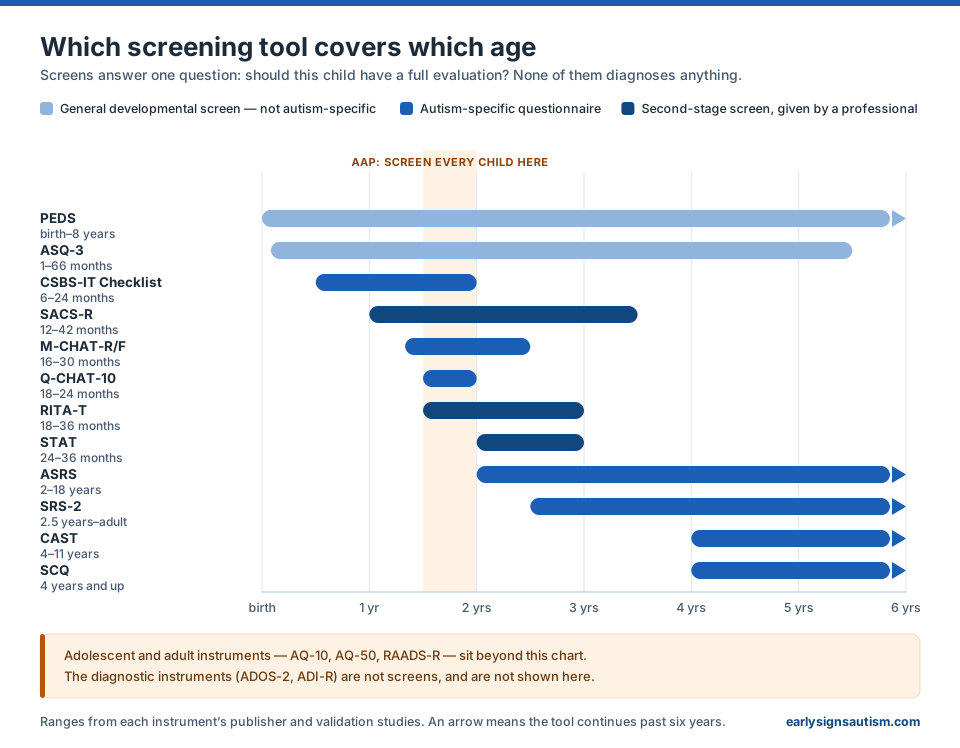
General developmental screening
These check development broadly. They are the screens most families actually encounter — and neither is an autism screen, which is the single most useful thing to know about them.
| Test | Age range | In one sentence |
|---|---|---|
| ASQ-3 | 1–66 months | The most widely used developmental screener in U.S. well-child visits — five domains, parent-completed. |
| PEDS | 0–8 years | Screens by eliciting parents' concerns and sorting them by how predictive research says they are. |
Autism screening — babies and toddlers
| Test | Age range | In one sentence |
|---|---|---|
| CSBS-DP Infant-Toddler Checklist | 6–24 months | Catches early communication concerns even before M-CHAT age — the earliest validated screen here. |
| M-CHAT-R/F | 16–30 months | The standard toddler screen: 20 parent yes/no questions, free online, recommended for every child at 18 and 24 months. |
| SACS-R | 12, 18, 24 months + 3.5 years | Not a questionnaire but repeated professional observation — the strongest published early-detection accuracy data. |
| STAT | 24–36 months | An interactive, play-based screen run by a trained professional for children already flagged by a first screen. |
| RITA-T | 18–36 months | A 10–15 minute interactive screen designed to triage children waiting for a diagnostic evaluation. |
Autism screening — children, teens and adults
| Test | Age range | In one sentence |
|---|---|---|
| CAST | 4–11 years | A free parent questionnaire for mainstream-school children — built for the late-identified, "coping at school" profile. |
| SCQ | 4+ years | A 40-question parent form based on the ADI-R, common for school-age children. |
| SRS-2 | 2.5 years – adult | Rates social communication traits on a scale rather than yes/no — also used to track change over time. |
| ASRS | 2–18 years | Norm-referenced parent and teacher ratings with treatment scales, repeatable for progress monitoring. |
| AQ-10 & Q-CHAT-10 | Toddlers / 4+ / adults | The ten-question versions — fast and free, used in UK NICE pathways, and the easiest to over-interpret. |
| AQ & RAADS-R | Adults | The self-report questionnaires used in adult assessment pathways — and what an adult diagnosis actually involves. |
Diagnostic instruments
| Test | Format | In one sentence |
|---|---|---|
| ADOS-2 | Direct observation | The closest thing to a gold standard: a semi-structured play and conversation session with standardized scoring, from 12 months to adulthood. |
| BOSA | Observed play | A short observation in which a caregiver plays with the child while the clinician watches — the practical ADOS alternative. |
| ADI-R | Parent interview | A deep structured interview about your child's developmental history — often paired with the ADOS-2. |
| MIGDAS-2 | Sensory-based interview | Produces a narrative description rather than a score — often chosen for girls, adults, and subtler presentations. |
| CARS-2 | Clinician rating | A 15-item rating scale a clinician scores from observation and parent input. |
| GARS-3 | Parent/teacher rating | A norm-referenced rating scale common in U.S. school eligibility evaluations. |
| DISCO & 3di | Structured interviews | Comprehensive diagnostic interviews used mainly in the UK and Europe. |
| Vineland-3 | Caregiver interview | Not an autism test — it measures everyday adaptive skills and support needs, and belongs in nearly every full evaluation. |
What about online autism tests?
Free online quizzes range from legitimate screeners (the official M-CHAT-R/F, the AQ) to marketing funnels with no validation at all. The rule is simple: a legitimate tool tells you whether to seek an evaluation and points you to professionals; anything that claims to tell you whether you or your child are autistic — or sells you a "result," a supplement, or a program on the way out — is not a test, it's a product. See myths & facts.
Always part of a real evaluation: a hearing test. Hearing loss can mimic nearly every early sign of autism — no evaluation is complete without ruling it out.
Where results lead
Whatever instrument starts the journey, the path is the same: screening flag → comprehensive evaluation → (if criteria are met) diagnosis → support. And in the U.S., support can start before any of it — see next steps for how early intervention works without a diagnosis.
Medical disclaimer: Educational information only. Test names are trademarks of their respective publishers; this site is not affiliated with any of them and does not reproduce any test content. No page here can diagnose autism — consult a qualified clinician.