Early signs of autism, age by age
Autism affects social communication and interaction, and involves focused interests, repetitive behaviors, or sensory differences. In the first years of life it shows up mostly as differences in social connection and communication — often subtle, and often noticed first by parents. Here is what research says to look for at each age.
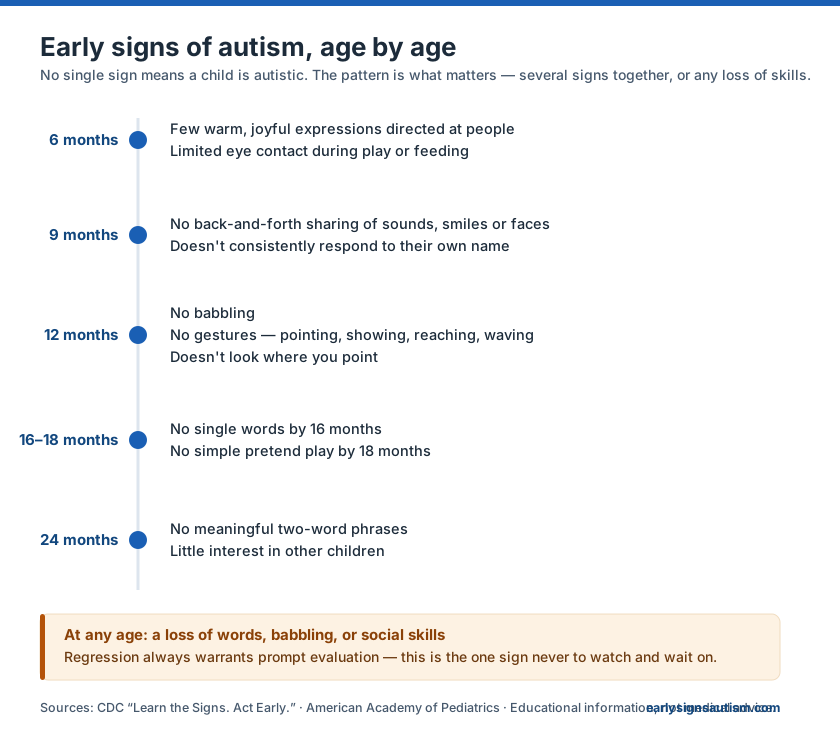
How to read this page. Every child develops at their own pace, and a single item from any list below means very little on its own. What matters is the pattern: several signs together, signs that persist over weeks, or any loss of skills. Check what you observe, then print the page and bring it to your child's doctor — specific observations are far more useful than "I'm worried."
Privacy note: your checkmarks are stored only in your own browser, on your device. Nothing you mark here is sent, saved, or seen by anyone else.
Six months: shared joy
At this age, typical development centers on emotional back-and-forth. Possible early differences:
- Few or no big smiles or other warm, joyful expressions directed at people
- Limited eye contact during feeding, play, or talking
- Little response to playful interaction (peek-a-boo, silly faces) — seems more interested in objects than faces
- Doesn't turn toward familiar voices or seem soothed by them
Six months is very early — differences here are subtle and easily explained by temperament, hearing, or vision. Mention them at your well-child visit rather than waiting.
Nine months: back-and-forth
- No back-and-forth sharing of sounds, smiles, or facial expressions
- Doesn't consistently respond to their own name (with normal hearing)
- Doesn't look at you when you talk or play with them
- Little babbling or vocal play compared with peers
- Doesn't follow your gaze when you look at something
Not responding to name by 9–12 months is one of the best-replicated early markers in autism research. Always pair it with a hearing check — hearing loss can look identical.
Twelve months: gestures and joint attention
This is the age of joint attention — the ability to share focus on something with another person. Its absence is a core early sign.
- No babbling (strings like "ba-ba-ba," "da-da")
- No gestures: no pointing, showing objects, reaching to be picked up, or waving bye-bye
- Doesn't point to show you something interesting (pointing to request comes earlier and is different from pointing to share)
- Doesn't look where you point ("Look, a dog!")
- Doesn't bring or show you objects just to share them
- Doesn't imitate simple actions (clapping, waving)
- Strong, unusual interest in specific objects (spinning wheels, lights, textures) rather than people
Sixteen to eighteen months: first words and pretend play
- No single words by 16 months (other than mama/dada)
- No simple pretend play by 18 months (feeding a doll, "drinking" from a toy cup, pretend phone calls)
- Doesn't point to interesting things or share attention
- Doesn't follow simple one-step directions with gesture cues
- Repetitive movements become more visible: hand flapping, spinning, rocking, walking on toes
- Lines up toys or focuses on parts of toys (wheels, hinges) rather than playing with them functionally
- Unusual sensory responses: distress at everyday sounds, indifference to pain or temperature, fascination with lights or movement, strong food texture aversions
18 months is also the age of the first recommended autism-specific screening (M-CHAT-R/F) at well-child visits in the U.S.
Two years: combining words, connecting with peers
- No meaningful two-word phrases by 24 months (beyond direct imitation — "want juice" counts; echoing "want juice?" back does not)
- Little interest in other children — doesn't watch, approach, or imitate them
- Speech that is mostly repeated phrases from shows or adults (echolalia) rather than flexible communication
- Doesn't imitate your everyday actions (sweeping, cooking, phone use)
- Strong insistence on sameness: intense distress at small changes in routine, routes, or object placement
- Very intense, narrow interests unusual for age
Regression: the sign that always needs prompt attention
About one in four autistic children shows a loss of previously acquired skills — most often words, babbling, eye contact, or social engagement — typically between 15 and 24 months. Any regression, at any age, warrants an evaluation without delay. It does not mean something "happened" to your child; regression is a recognized part of how autism can unfold, but it should never be watched passively.
Signs in slightly older children (2–5 years)
Some autistic children — especially those with strong early language, and disproportionately girls — are missed as toddlers. In preschoolers, look for:
- Talks at people about favorite topics rather than having back-and-forth conversations
- Struggles to make or keep friendships with same-age children; plays alongside rather than with
- Takes language very literally; difficulty with jokes, pretend scenarios directed by others
- Rigid routines and rituals; big reactions to unexpected change
- Scripts entire scenes from media; speaks in a flat, sing-song, or formal tone
- Sensory overload in noisy, busy places (meltdowns that are not tantrums — they are overwhelm, not defiance)
- In girls especially: quiet social "masking" that collapses into exhaustion or meltdowns at home
What these signs are not. Preferring to play alone sometimes, being shy, late talking with otherwise strong social connection, toe-walking alone, or picky eating alone — none of these by themselves indicate autism. And the presence of eye contact, affection, smiling, or humor does not rule autism out. Autistic children laugh, cuddle, and love their parents.
What to do with what you've noticed
If several items on this page describe your child, or any single "red flag" item (no babbling by 12 months, no words by 16 months, no two-word phrases by 24 months, any regression):
- Write down concrete examples with rough dates — specifics beat impressions.
- Ask your child's doctor for a developmental and autism-specific screening — by name.
- Read the step-by-step next-steps guide — including how to start early intervention without waiting for a diagnosis.
Sources
- CDC. Learn the Signs. Act Early. — Developmental milestones, 2 months to 5 years. cdc.gov/act-early/milestones
- CDC. Signs and Symptoms of Autism Spectrum Disorder. cdc.gov/autism/signs-symptoms
- Hyman SL, Levy SE, Myers SM; AAP Council on Children with Disabilities. Identification, Evaluation, and Management of Children With Autism Spectrum Disorder. Pediatrics 2020;145(1). publications.aap.org
- First Words Project, Florida State University — early gestures and social communication markers ("16 gestures by 16 months"). firstwordsproject.com
- Prevalence and identification-age figures cited on this site: see the sourced statistics page.
Medical disclaimer: This page is educational information based on CDC "Learn the Signs. Act Early." milestones, American Academy of Pediatrics guidance, and published early-markers research. It is not medical advice and cannot diagnose your child. Discuss any concerns with a qualified clinician.