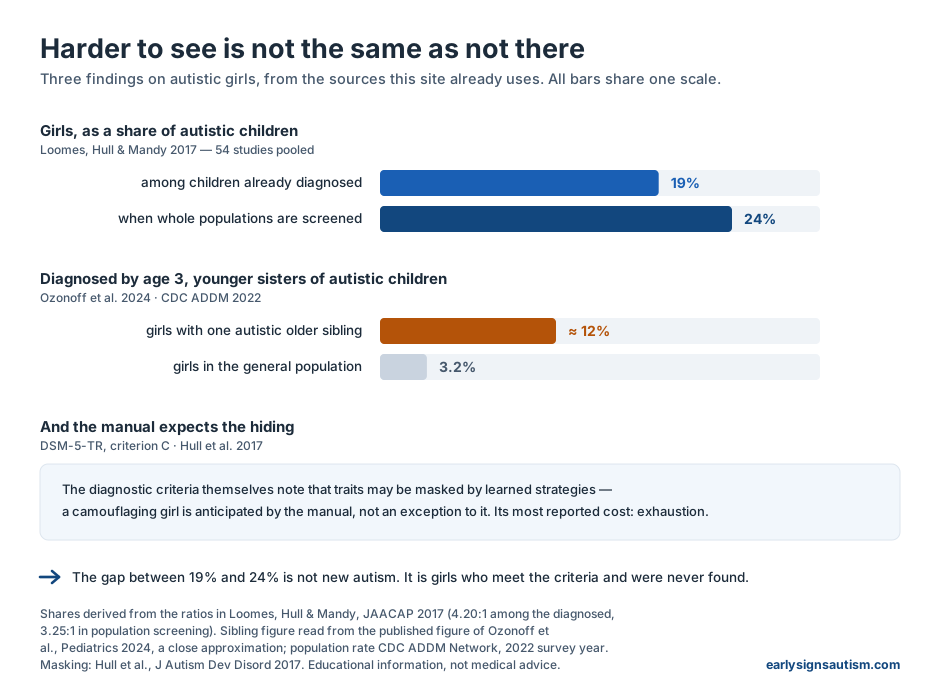
One number frames everything else. Among children who already have a diagnosis, boys outnumber girls about four to one. But when researchers screen whole populations instead of counting existing diagnoses, the ratio drops toward three to one. The difference is not new autism — it is girls who meet the criteria and were never found. Loomes, Hull & Mandy 2017, meta-analysis of 54 studies
How many girls are missing
The meta-analysis puts numbers on it: the male-to-female ratio is 4.20 to 1 among children already diagnosed, and 3.25 to 1 in studies that screened everyone regardless of diagnosis. Put as shares, girls are about 19% of diagnosed autistic children but about 24% of autistic children when everyone is looked at. The authors' own conclusion: girls who meet criteria for autism are at "disproportionate risk of not receiving a clinical diagnosis."
The system is catching up, slowly. In CDC surveillance the identified ratio has narrowed from 4.2:1 (2018 survey year) to 3.8:1 (2020) to 3.4:1 (2022) — each step closer to what population screening suggests is really there. CDC ADDM Network, 2022 survey year
What masking actually looks like
The single most consistent description, from research and from autistic women themselves, is camouflage: watching what other children do and copying it, rehearsing conversations in advance, forcing eye contact because it is expected, holding everything together at school — and falling apart at home, where it is safe. In the study that mapped this in detail, the most consistently reported cost was exhaustion. Hull et al. 2017, interviews with 92 autistic adults
Day to day, that can look like:
- A teacher who says "no problem at school" while evenings at home are meltdowns and tears
- Friendships managed through one intense friend who handles the social world for her
- Intense, narrow interests that pass as typical — animals, characters, reading — and so are never flagged
- Scripted or rehearsed-sounding conversation that works until the script runs out
- Extreme fatigue after birthday parties, school days, or anything socially demanding
"Fine at school" is not evidence against autism. It can be the most visible form of it: the effort of appearing fine is exactly what collapses at home.
Why standard assessments can miss her
This is not a fringe claim — it is written into the diagnostic manual. DSM-5-TR's criterion C states that traits may not become fully apparent until social demands exceed capacity, or may be masked by learned strategies later in life. A girl who camouflages is not an exception to the criteria; she is explicitly anticipated by them. The criteria, in plain language.
The practical consequence: a verbally fluent girl can perform well through a one-hour structured observation like the ADOS-2 — masking is that instrument's known blind spot. If an assessment comes back "not autistic" but daily life keeps saying otherwise, say exactly that to the evaluator, and bring specific observations and videos from home.
The family numbers
The sibling data makes the asymmetry concrete. Among younger siblings of autistic children, about 1 in 5 are diagnosed by age 3 — but the group least likely to be flagged, girls with one autistic older sibling, still sits at roughly 12%. That is around four times the general-population rate, in exactly the group most likely to be told "she's fine." Ozonoff et al. 2024, Baby Siblings Research Consortium More in the FAQ.
What to do if this sounds like your daughter
-
Use the same screening every child should get
The M-CHAT-R/F at 18 and 24 months, and developmental screening at 9, 18 and 30 months. For an older girl, the school-age screeners are on the tests page. A screener can under-detect a masking child — treat a negative score plus persistent concerns as a reason for evaluation, not reassurance.
-
Document home, not just school
Clinicians weight what they can see. Write down specific moments — what happened, what it cost her afterwards — and take short videos of the hard evenings. The signs-by-age checklist prints a summary you can hand to the doctor.
-
Say the word, and name the pattern
"I am concerned about autism. She holds it together at school and falls apart at home, and it is costing her more every year." That sentence tells an evaluator exactly which presentation to look for. The rest of the plan is on next steps.
Sources
- Loomes R, Hull L, Mandy WPL. What Is the Male-to-Female Ratio in Autism Spectrum Disorder? A Systematic Review and Meta-Analysis. J Am Acad Child Adolesc Psychiatry 2017;56(6):466–74. PubMed 28545751
- Hull L, Petrides KV, Allison C, et al. "Putting on My Best Normal": Social Camouflaging in Adults with Autism Spectrum Conditions. J Autism Dev Disord 2017;47(8):2519–34. springer.com
- CDC. Prevalence and Early Identification of Autism Spectrum Disorder Among Children Aged 4 and 8 Years — ADDM Network, 16 Sites, United States, 2022. MMWR Surveill Summ 2025;74(2). cdc.gov
- Ozonoff S, Young GS, Bradshaw J, et al. Familial Recurrence of Autism: Updates From the Baby Siblings Research Consortium. Pediatrics 2024;154(2):e2023065297. PubMed 39011552
- American Psychiatric Association. DSM-5-TR, autism spectrum disorder, criterion C — paraphrased here; the manual's wording is copyrighted. psychiatry.org/dsm